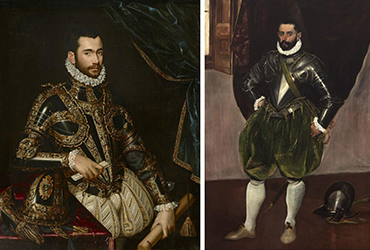
Left: Scipione Pulzone (c.1540/42-98), Jacopo Boncompagni, 1574, Oil on canvas, 48 x 39 1/8 inches
Private collection, courtesy of Jean-Luc Baroni Ltd. - Photo: Michael Bodycomb
Right: El Greco (1541 - 1614), Vincenzo Anastagi, c. 1575, Oil on canvas, 74 x 49 7/8 inches
The Frick Collection, New York - Photo: Michael Bodycomb
It doesn’t get much better than a Sunday afternoon at the Frick; for the consummate portrait connoisseur the collection is pure joy with a display of masterworks ranging from Titian to Whistler and everything in-between. Not that one needs an excuse to visit the Frick, but the current foray was inspired by an article in the New York Times covering a recently opened exhibition titled “Men in Armor.”The show, comprising two portraits hung side by side, one by El Greco and the other by Scipione Pulzone, offered a familiar “compare and contrast” theme of a then popular portrait genre among the nobility--armor being the fashionable power suit of its day.The favorable review noted that the portrait by El Greco was full length--indeed rare as he had painted only two in his entire lifetime.
Likely this is a truism for most old masters whose works we have become acquainted with through mass reproduction, but experiencing an El Greco firsthand is an absolute requirement to understanding and appreciating his formidable expressive powers.Heir apparent to Venice’s artistic genius, El Greco’s bravura brushwork, brash color harmony, and blatantly illogical pictorial space comes together to create an otherworldly view that simultaneously realizes a truly modern form while reimagining and reinvigorating devotional imagery.
The El Greco portrait is of a rising Roman noble named Vicenzo Anastagi.The portrait was painted soon after the artist arrived in the city and was an important showpiece for securing steady patronage.Putting aside for a moment the more thannormal creative restraints placed on this commission, the work at first glance appears exceedingly tame for an El Greco--near fussy in its attention to naturalist detail.For those familiar with El Greco’s flights of ecstatic imagineering (and wanting more) the work is rather unremarkable.Even the realism El Greco strives for fades in comparison to its curated foil--the portrait by Scipione Pulzone--whose skill at depicting everything, but most importantly the glint of bling, pretty much explains his popularity with the moneyed armored set. One imagines that we are experiencing an El Greco who is working super hard to please his patron, but has yet to discover his true artistic intent—the ability to express a reality beyond the realm of verisimilitude.
Yet, El Greco’s true genius and genuine artistic intent does reveal itself--even at this nascentstage. To spot its ascendancy one needs to look beyond clumsy execution to see what is in fact an earnest search for a new expressive form. Compare for example the handling of background drapery in both works.In his portrait, Pulzone decorates the background with a superbly painted velvet swag so lifelike you can feel the raise of the nap. Alternatively, El Greco’s drapery becomes an opportunity to explore form and space—or to symbolize a narrative—albeit obscure. In any event, one can’t be quite sure what is going on behind Anastagi—save that it is both confusing and fascinating.But this much we can be sure of, the seeming botched effort to paint drapery takes on special significance when we consider El Greco’s mature work. Increasingly the artist rejects naturalistic effects and instead renders backgrounds, interiors, and landscapes as if they are theatrical props. Skies are equally abstracted and symbolic—they become projection scrims that separate the material world from the "behind the scenes" spiritual realm.
Next cue that points to where El Greco is headed stylistically: where exactly is Anastagi standing?As with his rendering of drapery, is El Greco simply struggling with technique issues and unable to ground his subject in illusionistic space?This seems unlikely. Could an artist of El Greco’s talent and training be unable to deliver on perspective?My guess is that, like his handling of drapery, El Greco is seeking to express a spirited presence that cannot be supported through adherence to drawing conventions based on observations of the material world.El Greco’s turning away from Pulzone’s realism is subtle but determined. By suppressing details and distilling the background into two bands of color El Greco compresses pictorial space.Deprived of perspective cues, we no longer sense that this is a “real” room—but rather one that is deliberately staged to deliver a specific effect.
So what effect is El Greco after?I would argue that he is reinstating spiritual content that the art of his time had lost in its quest to mimic the natural world—and he reached back to highly stylized medieval art forms to find it. The Anastagi portrait is a mere start; ultimately El Greco’s figures dissolve feet first in ambiguous spaces that bear little resemblance to our mere mortal existence. As such El Greco invents the perfect expression for his time—a cutting edge imagery that inspires the druggy devotional reveries of the Counter-Reformation.
"Men in Armor: El Greco and Pulzone Face to Face" is on view through October 26th. For more information, visit www.frick.org.
Portraits, Inc. was founded in 1942 in New York on Park Avenue. Over its 70-year history, Portraits, Inc. has carefully assembled a select group of the world’s foremost portrait artists offering a range of styles and prices. Recognized as the industry leader, Portraits, Inc. provides expert guidance for discerning clients interested in commissioning fine art portraits.